Burn-in Testing and Burn-in Sockets: FAQs Answered
2026-03-03
Burn-in Testing and Burn-in Sockets: FAQs Answered
After semiconductor devices are packaged, reliability becomes a key quality metric before product shipment. To ensure stable operation in real-world conditions, engineers typically perform Burn-in Tests and Reliability Assessments (RA) to screen unstable chips and evaluate long-term performance. The Burn-in Socket plays a key role in these tests, providing reliable contact and stable electrical performance under high temperature, high voltage, and extended operation.
This FAQ is designed to help engineers better understand Burn-in test procedures, socket features, and selection criteria, serving as a practical reference for reliability verification.
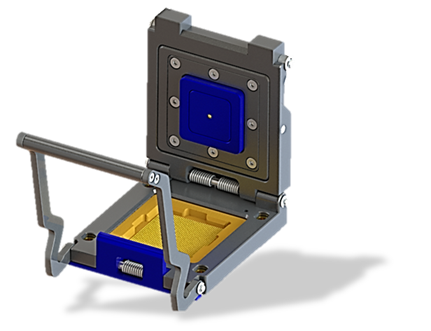
Q1: What is Burn-in testing?
After IC packaging, Burn-in Tests and Reliability Assessments (RA) are performed to ensure the reliability and long-term stability of the ICs.
Burn-in testing screens and eliminates unstable chips by simulating conditions such as high voltage, high temperature, and long-term operation, thereby improving product reliability.
Reliability Assessment (RA) evaluates the performance and reliability of a chip over its intended lifespan to reduce failure risks and ensure stable operation during long-term use, enhancing product quality and credibility.
Q2: How is a Burn-in Test conducted?
Burn-in testing is used to screen ICs for early-life failures. The typical process includes the following steps:
- Connect to the Burn-in Board (BIB): Attach the test socket to the burn-in board, ensuring proper connections for power, signal lines, and thermal pathways.
- Insert ICs into the test socket: Place the ICs into the burn-in socket, making sure the probes contact the chip pads reliably and the IC is securely positioned.
- Set test conditions and apply heat: Configure voltage, current, and temperature according to the IC specifications, then place the ICs in a burn-in oven or heating system. When using an ITC (Independent Temperature Control) socket, each IC’s temperature is controlled individually, enhancing both test accuracy and reliability.
- Perform the burn-in test: Continuously power the ICs under controlled conditions while monitoring electrical parameters and temperature to ensure safe operation.
- Test completion and data analysis: After testing, remove the ICs and analyze the results to identify early failures or any performance anomalies.
- Sorting and follow-up: Qualified ICs proceed to mass production, while defective units are either scrapped or sent for rework.
Q3: What is a Burn-in Test Socket, and what requirements must it meet?
A Burn-in Test Socket is a critical interface in back-end semiconductor testing. It connects the IC under test to the burn-in board (BIB) and allows long-term stress testing under controlled conditions to screen for early-life failures.
In burn-in testing, the socket must meet the following key requirements:
- Wide temperature stability: The socket must withstand environmental changes from room temperature to high heat. Its materials should have low thermal deformation, ensuring precise alignment between the socket pins and the IC pads or balls throughout temperature cycles.
- Long-term electrical contact: Probes must maintain low resistance, and spring structures should be tested for extended compression to ensure stable contact over time.
- Material durability: The socket body and plating must resist oxidation and corrosion to prevent signal distortion under high-temperature and high-humidity conditions.
- Insulation and thermal balance: For power devices, the socket must provide high insulation (to prevent arcing) while offering efficient heat dissipation to avoid localized overheating.
- Secure mounting and uniform pressure: The socket must hold the IC firmly and maintain even contact pressure, supporting extended high-temperature and high-current testing.
Q4: What materials are used in Burn-in Sockets?
Burn-in socket bodies are typically made from high-performance engineering plastics to maintain dimensional stability at elevated temperatures. The probes are crafted from wear-resistant alloys with specialized coatings, ensuring reliable contact over many test cycles. For high-frequency applications, low-dielectric materials are used to preserve signal integrity.
Q5: Why choose DediProg Burn-in Sockets?
DediProg utilizes a modular design to accelerate development and shorten lead times. Our sockets and probes are designed, manufactured, and validated in-house through our own mass-production lines. This ensures that our solutions maintain superior consistency and reliability under high-current and extreme temperature conditions.
Read More:
Understanding PCR: Applications, Advantages, and Maintenance FAQs
The Engineer’s Guide to Pogo Pins: 15 Must-Know Q&As
How to Choose IC Test Interfaces? PCR vs. Pogo Pin: Comparison of Electrical Performance, Lifespan, and Cost
Explore More:
Burn-in Socket
ITC Test Socket
PCR (Pressure Conductive Silicone Rubber)
PCR Socket
PCB/R Socket
Pogo Pin
Final Test Socket
Open Top Socket
DDR5 Module Test Socket
DDR4 Module Test Socket
Not sure which testing solution fits your needs? Please contact us for a free evaluation.
 |  |  |  |

E-mail: sales@dediprog.com